
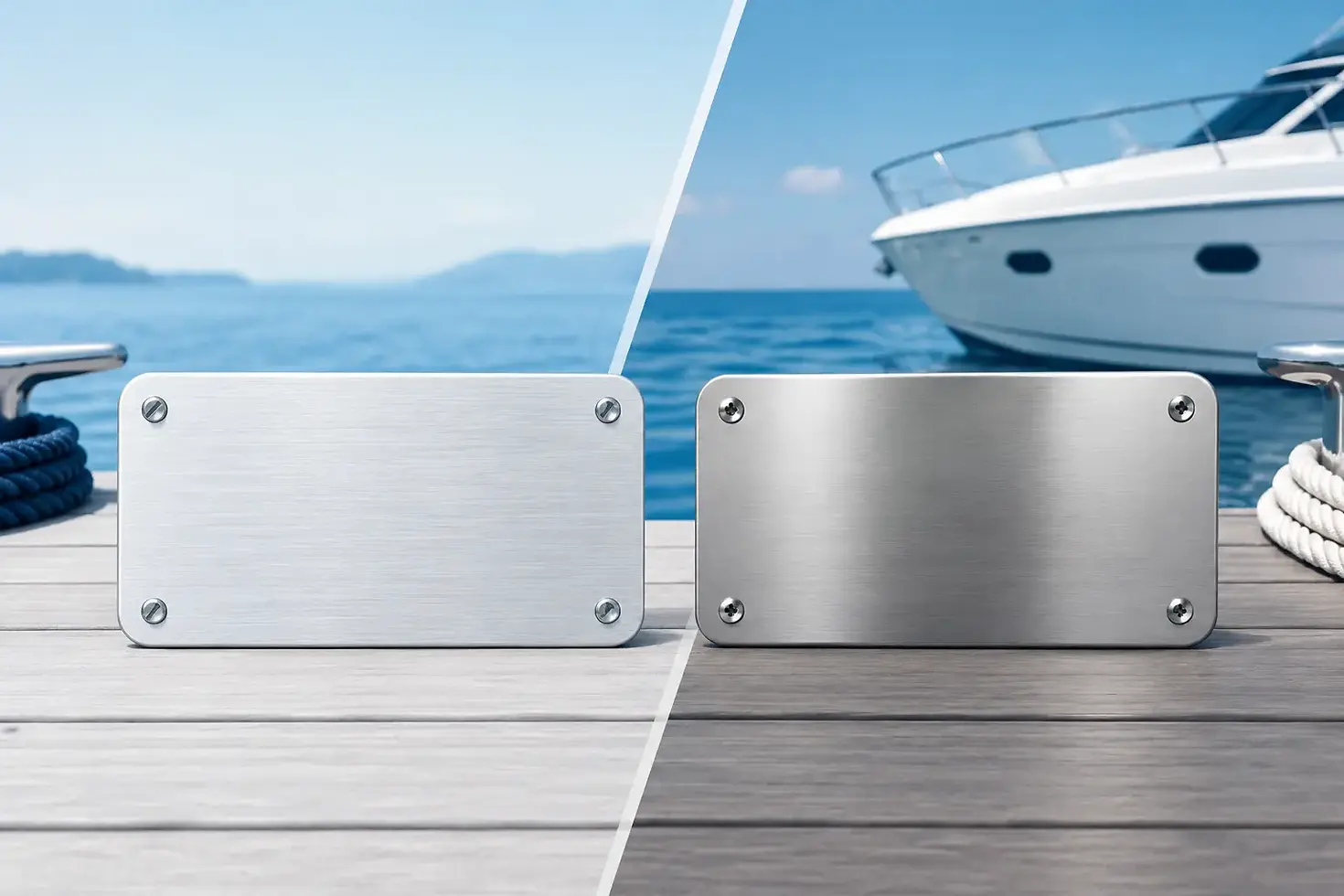
Aluminum Versus Stainless for Marine Boat Signs
A transom name sign spends its life exposed to salt spray, washdowns, UV, vibration, and changing temperatures. That makes aluminum versus stainless more than a styling decision. The material behind your vessel name affects how the sign holds its finish, supports LED lighting, resists corrosion, and looks after seasons at the dock and underway.
For a small, non-illuminated marking in a protected area, aluminum can be a sensible choice. For a premium illuminated yacht name intended to remain a defining feature of the vessel, marine-grade stainless steel is usually the stronger long-term answer. The right choice still depends on the installation location, vessel type, sign design, and finish you expect years from now.
Aluminum versus stainless in a marine environment
Aluminum is lightweight, widely available, and easy to machine. It can be powder coated, painted, anodized, or finished in a variety of colors. These qualities make it useful for certain marine components, particularly where weight is a major concern or the part will be protected from direct exposure.
The challenge is that bare aluminum is not automatically trouble-free around saltwater. It forms a natural oxide layer, but chloride exposure, standing water, abrasion, and contact with dissimilar metals can all create opportunities for corrosion. Painted and powder-coated aluminum depend heavily on proper preparation, coating quality, sealed edges, and careful installation.
Stainless steel is heavier, but it offers a more substantial appearance and better durability for exposed custom signage when the correct alloy is used. Not all stainless is equal. For marine boat signs, 316L stainless steel is the material to look for. Its molybdenum content improves resistance to pitting and crevice corrosion compared with common 304 stainless, while the low-carbon composition supports clean fabrication and welding where required.
That does not mean stainless steel is maintenance-free. Salt deposits should still be rinsed away, and the surface should be cleaned with appropriate non-abrasive products. But a properly fabricated 316L sign gives owners a material foundation suited to the environment rather than one that relies entirely on a surface coating to stay protected.
Why salt exposure changes the calculation
A boat sign is not installed in laboratory conditions. Water can collect behind letters, around mounting studs, and along seams. Hardware, backing surfaces, and wiring paths may introduce different metals into the assembly. These details are where material selection becomes practical rather than theoretical.
Aluminum needs thoughtful isolation from stainless hardware, copper-based components, and other dissimilar metals. Without that separation, galvanic corrosion can occur when moisture bridges the materials. A quality installation can manage this risk, but it requires attention to mounting methods, gaskets, sealants, and drainage.
Stainless also benefits from correct installation practices, especially on aluminum hulls or structures. The goal is not simply to choose a premium metal. It is to design the complete sign and mounting system so that water does not remain trapped and dissimilar materials are properly isolated.
Finish quality: painted color or polished metal
The visual difference between aluminum and stainless is often obvious before a sign is even illuminated. Aluminum is highly adaptable for painted or powder-coated color. If your design calls for a bold hull-matching finish, flat black lettering, or a custom color statement, aluminum can provide a useful substrate.
However, coatings are the visible layer. A chip, scratch, or worn edge can expose the metal beneath, particularly on raised letters and sharp corners. Over time, the appearance of a coated aluminum sign depends on the integrity of that finish and the care it receives.
Stainless steel has a different kind of value. Brushed, polished, satin, and mirror finishes create depth that is inherent to the material itself. A polished stainless yacht name reflects surrounding water and light; a brushed finish delivers a refined, architectural look while hiding minor handling marks more effectively than mirror polish.
For many owners, this is the deciding factor. The sign is part of the boat's identity, not just a required label. Stainless gives illuminated letters a crisp, high-end face during the day, even before the LEDs come on at night.
Weight matters, but usually less than expected
Aluminum is considerably lighter than stainless steel. On a performance-focused vessel, weight deserves respect, especially when a project involves large panels, extensive metalwork, or equipment placed high above the waterline.
For most individual transom names and illuminated boat signs, though, the total material weight is modest relative to the vessel. The difference between aluminum and stainless letters is rarely the factor that determines real-world performance. Sign size, backing construction, cable routing, mounting surface, and illumination components often have a greater effect on the overall installation.
Large-format logos are an exception. If a design covers a broad area or includes a substantial backing plate, a lighter material may be worth considering. That is why custom dimensional drawings are valuable before fabrication. They allow the sign to be evaluated as a complete assembly, not just as a material sample.
LED boat signs need a stable, precise foundation
An illuminated sign has more to accomplish than a flat-cut name. It must hold its shape, provide a clean face for the lettering, maintain consistent spacing from the mounting surface, protect wiring, and distribute light evenly across every character.
Stainless steel performs particularly well in this role because it can be fabricated into precise returns, raised letters, and durable housings. It supports the dimensional presence expected from a premium backlit yacht name. The face remains visually strong in daylight, while the engineered lighting system creates the effect after dark.
Aluminum can also be fabricated for illuminated applications, and there are projects where it is appropriate. But the sign design must account for coating durability, edge protection, hardware isolation, and the visual finish the owner expects over time. A low-profile painted logo and a polished, halo-lit yacht name are not asking the same material to do the same job.
Light color and metal finish should be selected together
Cool white LEDs can emphasize the clean, contemporary look of brushed or polished stainless. Warm white lighting can create a softer, more classic appearance. Blue, red, and other colors can be striking, but they should complement the vessel's existing lighting plan rather than compete with it.
The metal face influences that presentation. Stainless adds reflection and contrast around the glow, while coated aluminum offers more control over the daytime color of the sign. Reviewing production artwork and dimensional drawings before fabrication helps ensure the material, finish, font, and lighting are working as one design.
Choosing the right material for your vessel
Start with the location. A sign mounted on an exposed transom, swim platform, or exterior cabin surface faces more salt, sunlight, and physical contact than a protected interior or covered cockpit application. The harsher the exposure, the more compelling 316L stainless becomes.
Then consider the intended lifespan. If the project is a short-term update or a simple non-illuminated identifier, aluminum may meet the need at a lower initial cost. If the sign is meant to carry the boat's name through years of ownership, refits, and resale conversations, stainless can be the better investment.
Finally, consider the level of finish. A premium yacht deserves more than letters that are merely readable. The best signs are designed around proportion, letter spacing, viewing distance, hull color, and nighttime visibility. Material selection should support that complete result.
At Nauticalite, custom 316L stainless-steel illuminated signs are built around this standard. Artwork and dimensional drawings allow owners, captains, and refit teams to confirm fitment before production, while installation-ready components simplify the final stage on the vessel.
Initial price versus long-term value
Aluminum often carries a lower material cost and may be quicker to source for straightforward projects. That can make sense when budget, low weight, or a painted finish is the priority.
But the lowest initial cost is not always the lowest ownership cost. Recoating, replacing weathered letters, correcting corrosion around hardware, or upgrading an underwhelming sign later can quickly change the equation. A well-designed 316L stainless sign costs more because the material, fabrication, finish, and lighting system are engineered for a demanding marine setting.
Your vessel name should look intentional from the first approach at the dock and still look right after countless miles, washdowns, and seasons on the water. Choose the material that matches the conditions your sign will actually face, then give the design the level of craftsmanship your boat deserves.



Comments